The total moment of inertia of a thin ring mass around its central axis is given by I=mr² and I=1/2mr² around its other (diametrical) axes. 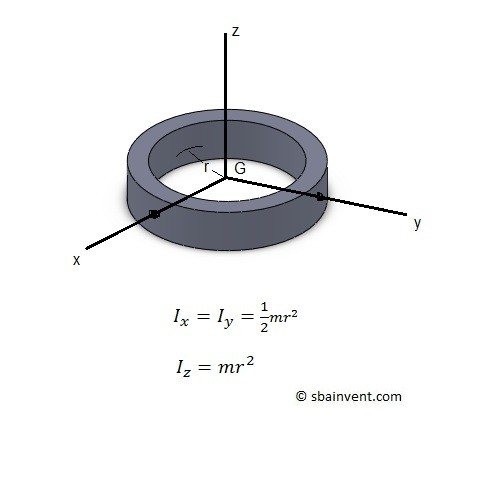 Conservation of angular momentum and forced precession. Let's take the example of a ring mass attached to an axle that is set in motion around one of this I=1/2mr² diametric axis. Using the parallel axis theorem we can find the total moment of inertia of the system to be Itotal = Md² + 1/2Mr² as shown below.  Conservation of angular momentum and forced precession. This is all basic stuff. But what happens when we give the ring mass some spin angular momentum while we rotate it around like we did before? Well now this looks like a precessing gyroscope. However the precession here is forced due to it being rotated around. But whether it's forced or not the crucial part is that a precessing gyroscope has no angular momentum along its precession axis because its "rotation" is merely an illusion called "precession" unlike real diametrically rotating ring mass that has a MoI of 1/2Mr² In conclusion the total moment of inertia reduces to the radius/distance squared times the center of mass of the ring because the diametric moment of inertia component is dropped due to gyroscopic precession.  Conservation of angular momentum and forced precession. That is the theory at least. The real question is does spinning mass actually affect the total moment of inertia of a system. And if it does what does it mean to have a mechanism that allows you to significantly drop the rotational mass of said system while it is rotating. Angular momentum conservation is king at the end of the day and if rotational mass suddenly drops then the only quantity that can go up proportionally is angular velocity (because of L=I⋅ω) to keep angular momentum constant. However rotational energy has a squared dependency on angular velocity E = 1/2 Iω² so where did that extra energy come from?
|

 Author
Topic: Conservation of angular momentum and forced precession. (Read 74 times)
Author
Topic: Conservation of angular momentum and forced precession. (Read 74 times)
